Equity Group Holdings Plc delivered a strong Q3 2026 performance, with earnings growth reflecting the increasing scale of its regional businesses, a broader revenue base, continued strength across its banking and non-banking operations and the growing impact of its integrated, technology-enabled financial services model. Profit After Tax increased 32% to KSh71.5 billion from KSh54.1 billion, supported by sustained balance sheet expansion, improved asset quality, strong regional performance, and higher non-funded income.
Net interest income rose 15% to KSh107.7 billion from KSh93.5 billion, supported by the depth of the Group’s lending franchise and disciplined balance sheet management. Total income increased 23% to KSh192.0 billion from KSh156.2 billion, with non-funded income growing 34% to KSh84.3 billion from Ksh62.7 billion. Non-funded income now accounts for 44% of total income, up from 40.1% in Q3 2025, reflecting a broader revenue base across businesses, markets and customer activity.
The Group’s balance sheet grew by 18% to KSh2.15 trillion from Kshs 1.82 trillion , supported by a 19% increase in customer deposits to KSh1.58 trillion from Kshs 1.33 trillion and 17% growth in net loans to KSh1.01 trillion from Kshs 859.8 billion. The expansion reflects sustained customer confidence and healthy demand across Equity’s markets. Shareholders’ funds increased 22% to KSh369.7 billion from Kshs 303.2 billion, further strengthening the Group’s capital position. Equity now serves more than 24 million customers through Equity Online for Business & Individuals, Eazzy FX, the Equity Mobile App, *247#, and Equitel, complemented by 411 branches, 883 ATMs, 95,510 agency outlets and 1.4 million merchants. Together, these touchpoints give customers access to one of the region’s broadest financial services ecosystems.
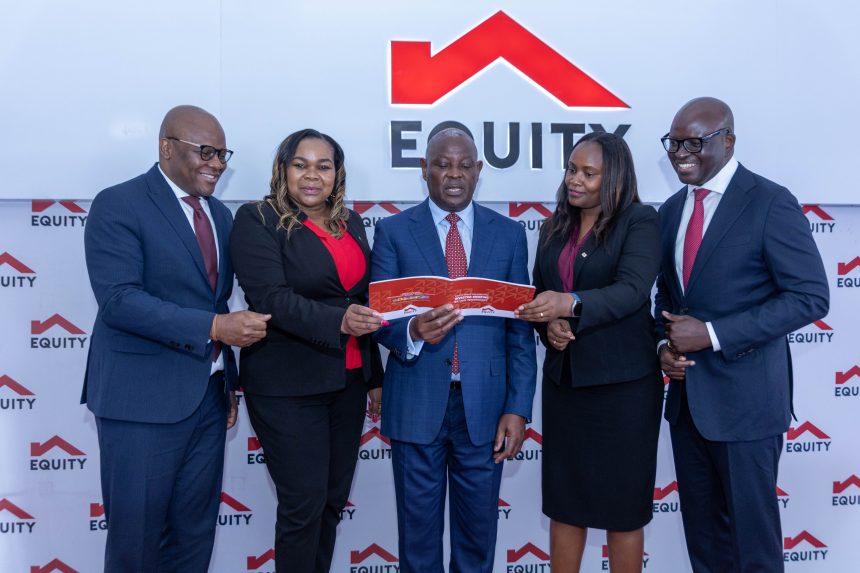
Releasing the Q3 2026 results Dr James Mwangi, Group Managing Director and CEO said,
“While operating conditions remain influenced by global geopolitical uncertainty and inflationary pressures in some markets, the Group remains confident in the resilience of the regional economies in which it operates. Across our markets, economic growth remains supportive, with Kenya expected to grow by 4.5%-5% and our regional subsidiaries continuing to operate in some of the world’s fastest-growing economies. Supported by structural reforms, infrastructure investment and favourable demographics, these markets continue to present significant long-term growth opportunities. Equity’s Q3 2026 performance reflects the successful execution of a multi-year transformation agenda that has strengthened the Group’s resilience, diversified its earnings base and enhanced operational scalability through technology. Our earnings profile is increasingly balanced across geographies, products and business lines, creating a more resilient and sustainable operating model and positioning the Group to capture opportunities across multiple growth corridors. As we continue investing in digital and AI-enabled capabilities, we are strengthening our ability to serve customers at scale, improve productivity and build a future-fit financial services institution.”
Operational efficiency strengthened further, with the cost-to-income ratio improving to 47.9% from 50.6%, supported by productivity gains, shared services and the ongoing shift in customer activity toward digital channels. Return on Average Assets stood at 4.6%, while Return on Average Equity reached 27.2%, reflecting strong asset productivity and disciplined capital allocation.
He added: “Our strong Q3 2026 performance demonstrates the resilience of our diversified regional franchise and validates our long-term strategy of building a digitally led financial services Group. Through disciplined execution and continued investment in technology, talent and distribution, we are creating a scalable platform capable of serving customers across multiple markets and financial needs under our One Equity ecosystem. As we advance our Africa Recovery and Resilience Plan (ARRP) 2030 ambitions, we continue to evolve beyond traditional banking into an integrated financial services platform that mobilises capital, connects customers to opportunities and drives inclusive economic growth across Africa. This transformation is increasingly evident in customer behavior, with 98.3% of transactions now conducted outside our branches and 89.5% processed through digital channels, demonstrating the scale, convenience and relevance of our digital ecosystem.”
Customer adoption of digital channels continued to deepen, with 98.3% of transactions conducted outside branches and 89.5% processed through digital platforms. The shift illustrates the reach of Equity’s digital ecosystem and the growing role of its technology infrastructure in enabling convenient, scalable access to financial services.
The Group continued to modernise its core systems, payments infrastructure and risk analytics while building workforce capability for an increasingly digital operating environment. Ninety-seven percent of staff have completed a business-focused generative AI course, while 72% completed two additional courses through the Huawei ICT Academy. In total, staff completed 163,860 hours of guided AI instruction. A further 714 staff were admitted to master’s degree programs through WorldQuant University in Financial Engineering and Applied AI. An additional 1,948 staff have enrolled in a brand-new MSc in Strategic AI and Innovation. These investments are strengthening service delivery, risk management, and the Group’s capacity to scale across markets.
As asset quality improved, the Group continued to maintain strong risk buffers. The NPL ratio declined to 9.3% from 12.1%, while NPL coverage remained at 71% year on year. Cost of risk improved to 1.5% from 1.9%. The progress reflects disciplined underwriting, stronger analytics and the benefits of a diversified portfolio, reinforcing the Group’s focus on long-term resilience and sustainability.
Equity Bank Kenya sustained its recovery, increasing Profit After Tax by 31% to KSh40.7 billion from KSh31.1 billion in Q3 2025. Assets grew 7%, supported by 10% deposit growth and 12% loan growth. Return on Average Assets and Return on Average Equity stood at 5.1% and 35.2%, respectively. The bank also maintained its MSME leadership, disbursing 34% of the KSh245 billion in MSME loans issued in Kenya between January and June 2026.
The regional subsidiaries continued to increase their scale and contribution to the Group, accounting for 42% of Group banking profitability, 50% of banking revenue, 54% of deposits, 55% of loans and 54% of banking assets. Equity BCDC in the Democratic Republic of Congo increased Profit After Tax by 34% to KSh18.5 billion. Equity Rwanda grew Profit After Tax 10% to KSh4.4 billion, while Equity Tanzania delivered 60% growth to KSh2.4 billion. The performance underscores the increasing depth of the Group’s pan-African franchise.
Equity Insurance Group extended its growth trajectory, with Gross Written Premiums increasing 52% to KSh10 billion and Profit Before Tax rising 34% to KSh1.96 billion year on year. The life and general insurance businesses wrote KSh7.5 billion and KSh1.1 billion respectively, while the health insurance business recorded KSh1.3 billion in Gross Written Premiums. Life insurance policies issued to date reached 23.7 million, with 7.3 million unique customers consuming life insurance products, while 41,208 Micro and Small Enterprises (MSMEs) consumed general insurance covers. Eighty percent of the policies issued by the Insurance Group were distributed digitally, widening access and supporting the resilience of families, businesses and communities.
The Group’s non-banking businesses also increased their contribution, accounting for 4.5% of Group revenue, up from 3%. Their contribution to Profit Before Tax rose to 3.7% from 3.6%, while their share of Profit After Tax increased to 3.2% from 3.1%.
The Equity Group Foundation (EGF) continued to extend its social and economic impact across Africa through Equity Group’s integrated model of economic empowerment, social impact and sustainability. Under Education and Leadership Development, EGF currently supports more than 11,663 active high school scholars. Global university opportunities expanded with 138 new admissions in 2026, valued at USD25.36 million (KSh3.3 billion). To date, 60,009 scholars have benefited from the Wings to Fly and Elimu scholarship programs, while the Equity Leaders Program has surpassed 10,505 cumulative paid internships. The number of scholars accessing global universities has reached 1,253, with more than 35,300 transitioning to public universities across Kenya, Rwanda, Uganda and the Democratic Republic of Congo. More than 4,039 young people in Kenya and the DRC have benefited from the Wings to Fly TVET Scholarship Program, with 33% pursuing IT and 31% science and engineering, alongside agriculture, hospitality, business and other fields.
Under Enterprise Development and Financial Inclusion, EGF has cumulatively trained more than one million entrepreneurs and facilitated over KSh457.1 billion in credit access to MSMEs, supporting entrepreneurship, financial inclusion and job creation across the region.
In Food and Agriculture, the Foundation continued to advance agricultural commercialization and climate resilience, including through the USD25 million SASTAIN program in partnership with Mastercard Foundation, which targets 60,000 smallholder farmers and Agri-MSMEs in Tanzania and the DRC.
Through its Energy, Environment and Climate Action pillar, EGF advanced sustainability initiatives by planting more than 50.2 million trees and expanding clean energy, water and sanitation solutions designed to strengthen environmental resilience and green growth. Equity Group Holdings also received accreditation as a Direct Access Entity (DAE) to the Green Climate Fund (GCF), a milestone that enables the Group to directly mobilise global climate finance in support of Africa’s climate resilience and sustainable development agenda. The accreditation strengthens Equity Group Foundation’s ability to scale climate adaptation and mitigation programmes by expanding access to catalytic concessional funding, blended finance and strategic partnerships across climate-smart agriculture, nature restoration, renewable energy, resilient health systems, green enterprise development and community resilience. Building on the Foundation’s implementation capacity and regional reach, GCF accreditation is expected to support the delivery of locally led climate solutions that protect livelihoods, create green jobs, strengthen communities and ecosystems, and advance Equity Group’s mission of transforming lives and livelihoods.
Equity Afya continued to broaden access to affordable, quality healthcare through its network of 159 medical centres, which have served more than 5.7 million patient visits. Equity Afya also opened its first two community pharmacy outlets, marking an initial step toward its vision of a targeted network of 1,000 community pharmacies across the region to expand access to affordable, high-quality medicines.
EGF’s Innovation and Technology Pillar continued to scale its initiative to partner with a broad range of learning platforms to expand access to high-quality technology upskilling opportunities. This includes a major drive to enrol Equity staff in graduate-level Masters degree programmes with WorldQuant University. 714 staff have been admitted to the university’s MSc in Financial Engineering programme. This quarter WorldQuant University added a second MSc programme option, MSc in Strategic AI and Innovation, and already 1,948 staff have been admitted. A total of 12,711 staff completed the GenAI course and progressed to two additional prescribed Huawei ICT Academy certification courses, which 8,599 staff have completed. Staff have completed a cumulative 163,860 hours of AI-focused instruction. 7,567 users are enrolled in iamtheCODE programmes. Together, these programmes are developing the skills and human capital required to support long-term growth and transformation across the Group’s markets.
With Return on Average Assets and efficiency at strong levels, the Group remains focused on disciplined execution of its 2030 strategy anchored on the Africa Recovery and Resilience Plan (ARRP). The strategy sets out ambitions to expand operations to 15 countries, serve 100 million customers and deploy next-generation digital and AI-enabled systems to scale transformation finance across the continent. The Group remains well capitalized with strong capital buffers sufficient to support its strategic objectives.