



New ID System Faces Questions Over Digital Verification
The rollout of new national identity cards has come under fresh scrutiny…


JOAN NANKYA: Why Uganda Needs a Health Insurance System That Prevents, Not Just Pays
Joan Nankya What if the most valuable health insurance claim is the…

Uganda, Egypt Partner to Manufacture Foot and Mouth Disease Vaccine Locally
Livestock farmers will be counting an extra saving after a factory to locally…

Equity Bank Regional Network Opens New Export Opportunities for UKI Uganda
As Ugandan manufacturers increasingly look beyond the domestic market, efficient cross-border financial…

MTN MoMo Champions Responsible Digital Credit Through New Financial Literacy Campaign
MTN Mobile Money (U) Limited has today launched a nationwide financial literacy…

dfcu Bank Pushes Integrated East African Financial System to Spur Industrialisation
dfcu Bank has called on commercial banks, regulators, and central banks across East Africa to build a fully integrated financial ecosystem that can unlock capital at scale, strengthen industrial competitiveness, and facilitate seamless cross-border trade. Speaking at the annual Regional Industrialisation Conference, convened by the Private Sector Foundation (PSFU), at Serena Kampala, dfcu Bank Chief Executive Officer Charles Mudiwa said traditional banking approaches centered largely on conventional commercial debt were not sufficient to drive the region’s industrial transformation. He said East Africa needs to broaden its understanding of capital beyond money to include market access, technical skills, and capabilities that enable businesses to produce, scale, and compete globally. “Capital is far more than cash. Capital is market intelligence, knowing where, how, and when to sell. Capital is also human capability, the technical skills and competencies needed to deliver value,” Mudiwa said. He explained that emerging Micro, Small, and Medium Enterprises (MSMEs) require a structured three-pronged intervention model combining technical production skills, financial literacy, and patient capital. To operationalize this model, Mudiwa said dfcu Bank has committed 1% of its annual net profits to the dfcu Foundation to create an interest-free catalytic funds. Under this setup, MSMEs receive risk capital and pay back only the principal alongside a minimal administration fee, shielding them from prohibitive interest rates. He cited dfcu Bank’s interventions in agricultural value chains, such as supporting cocoa growers in Kasese alongside Rabobank under the SEED program to move into commercial chocolate production, and school-based poultry initiatives, as functional models that de-risk primary producers. He noted that the catalytic funding model was introduced to help businesses overcome financing constraints, scale operations, and unlock new markets. By offering low-interest, highly affordable capital, the facility allows growth-stage enterprises to invest in expansion rather than being weighed down by high borrowing costs. According to Mudiwa, the catalytic funding model proves how dfcu can leverage capital to transform businesses beyond traditional lending constraints. He said dfcu is now scaling the initiative to transition beneficiary enterprises from local production into regional and international export markets. He said the framework embeds catalytic finance into a broader strategy that builds enterprise capacity, unlocks new markets, and fosters long-term economic growth. Private Sector Foundation Uganda (PSFU) Chief Executive Officer Stephen Asiimwe called for stronger coordination between governments and businesses to translate regional integration commitments into practical improvements in the operating environment. He emphasized the need to remove persistent barriers to the movement of goods, services, capital and people across EAC borders, arguing that private-sector competitiveness will remain constrained unless regulatory and logistical bottlenecks are addressed alongside financial reforms. Asiimwe said reducing the time and cost of moving goods across borders should be treated as a competitiveness priority, noting that delays impose direct costs on businesses through higher transport expenses, financing charges and lost market opportunities.

Stanbic Bank, Rotary Sign UGX 600 Million Partnership to Support Maternal and Child Health
For a woman in labour, the distance to the nearest health facility…
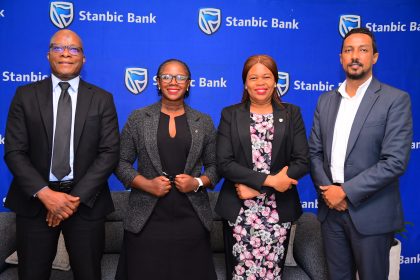
Stanbic expands access to unsecured loans with revamped ‘Oli in Charge’ campaign
Stanbic Bank Uganda has expanded access to unsecured loans under a revamped…

Secondary School students develop an irrigation system, menstrual belt
For many teenage girls and women, the arrival of their monthly period…

Euro Gold Refinery and Benard Feni Win Big at Business Excellence Awards 2026
Businessman and Gospel Artist Benard Feni alias Mungu Feni, over the Weekend,…